Thursday, October 25, 2012

Bariloche

At the National Homebrewers Conference this year, I attended a presentation by Dr. Diego Libkind (who called in via Skype) on the Patagonian origins of European lager yeast.  He threw up a gorgeous photo of his hometown - Bariloche, Argentina - and mentioned they had several craft breweries.  I was sold!

View from the hostel patio

Not a stock photo - I actually took this a few kilometres from downtown!


Aside from gorgeous mountains, lakes, skiing and hiking, chocolate and ice cream, there were in fact several craft breweries in town, and Dr. Libkind was nice enough to suggest a few for Mrs. Hoplog and I to try.


Bachmann


First up was Bachmann, a small operation in a cute house.


Tasters were available, and revealed that their schwarzbier was well worth another taste.  All beers were low in alcohol and bitterness, and nicely brewed.


My name is Chad, and I approve of this beer


Antares


Next up was Antares, a bigger brewpub with several locations, who also sells their beer in bottles.


The interior was certainly full-on craft beer bar, and it was busy.


The beer selection was excellent, though the quality was a bit lacking compared to Bachmann.  Only one beer was what I'd call bad, but none of them were "great."  (A lot of forgettable recipes and low-level flaws.)  Still, it was a well organized operation that is clearly seeing a lot of success.  Some higher-alcohol beers were present, but no hoppy/bitter beers (except the barleywine).

Nice range of beers, but I'm trying hard to forget that Octoberfest seasonal at the bottom right, ouch


Manush


We had to wait until Tuesday for Manush to open, but it was worth wait.  Very cozy, some nice beers, great food, and truly outstanding service.  A must-visit for a meal in Bariloche.

Happy Hour - 6 until 7 or 8 in Argentina - means 2 for 1 beers, but per person, no sharing!

A pretty nice little milk stout at Manush.  The Kolsch and Pale Ale were quite passable too

A couple of preliminary observations on Argentinian craft beer:

  • Cerveza artesenal exists in Argentina, and the movement seems to be progressing nicely.
  • My perception is that smaller craft breweries have difficulty controlling fermentation temperatures.  Perhaps large-scale refrigeration and/or heating is an expense they can't bear.  Anyway, many beers are a bit fruitier and "warmer" than usual, and some struggling yeast flavour is common.
  • Craft beer is subtle here - brewers aren't cranking out hop bombs and huge imperial stouts.  I would guess this is similar to a decade ago in BC, when beer consumers' palettes were still used to macro lager and were not ready for bigger, full-flavour beers.  So don't expect it to taste like Portland, OR here.  At least not yet.
  • If you have allergies, note that most craft beer bars provide all tables with a free snack of peanuts.

More Bariloche brewpubs still to come.


Mendoza

Next stop on the tour was Mendoza, Argentina (via a spectacular bus ride through the Andes from Santiago).  Not a ton going on here beer-wise (other than a brewpub beer garden that we didn't have time for, next to the Maipu wineries).  However, Mendoza is Argentina's premiere wine-growing region, so when in Rome...

Tasters at Tempus Alba

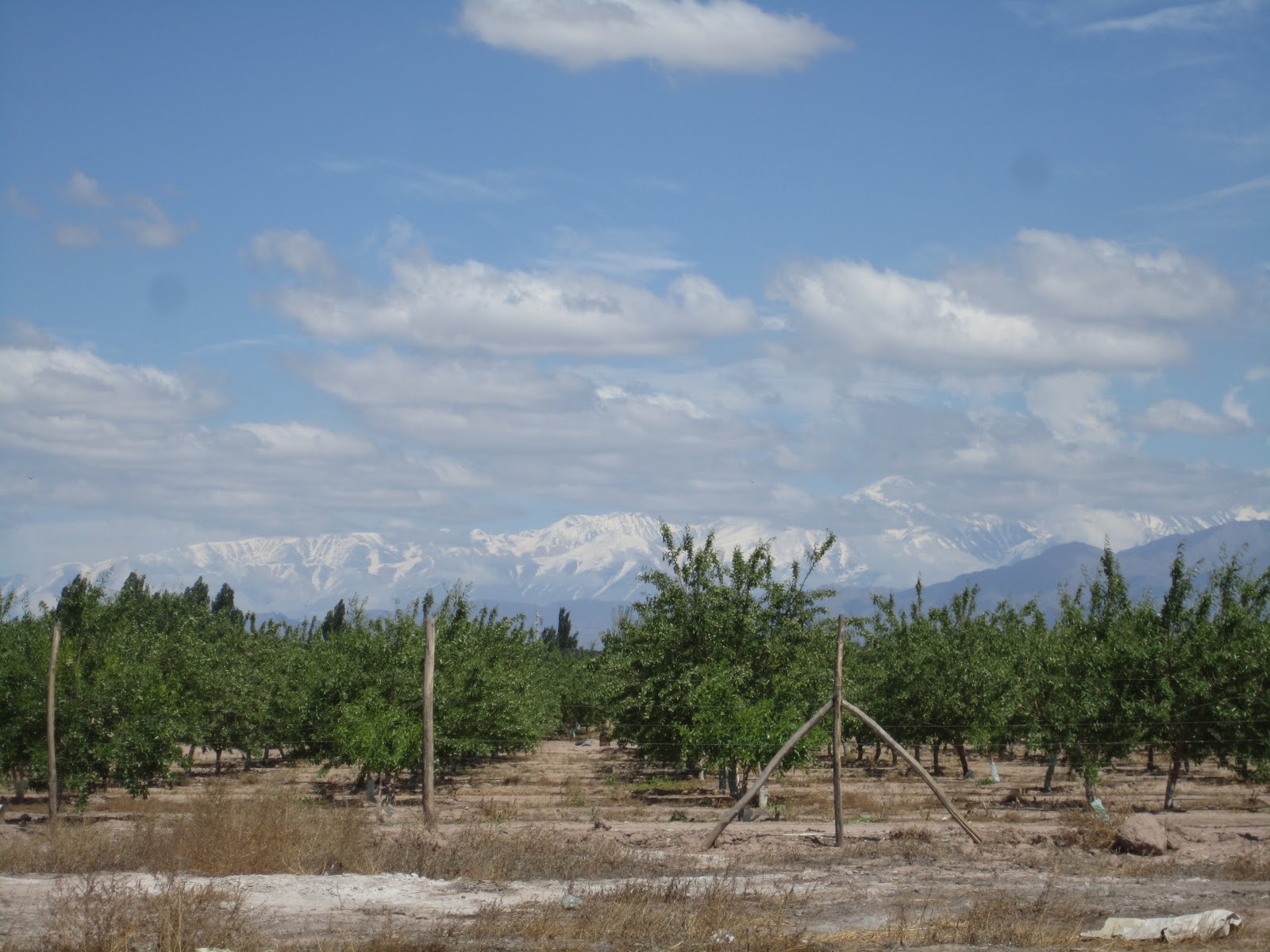
View from your bike while riding between wineries in Maipu.  That's Mt. Aconcagua in the background, the highest peak outside of the Himalayas.

Glass floor for viewing the barrel room from the (swanky) tasting room at Trapiche, Argentina's largest winery

Argentina also means asado!  Traditional Argentine meat grilling.


Our only beer experience of note was to sample one of the two national-brand macro beers with our pizza: Andes (the other is Quilmes).  Next to a can I once left in the freezer overnight, this was the coldest beer I've ever had.  The beer in the bottle was not frozen, not even once the cap was removed.  But as soon as I poured it into the (non-frozen) glass, it developed a slush on top.  I'm thinking that maybe the CO2 released while pouring brought enough carbonate out of solution to raise the freezing temperature of the beer just enough for ice to form.

Beer slush, anyone?

Storing bottles of this style/brand of beer below freezing is probably not the end of the world.  But all the beer and pop are kept in the same fridge/freezer down here, along with most of the beer glasses.  I see a lot of very foamy, very over-chilled beer in my near future!

First Beers in the Southern Hemisphere

What's the first thing I see in the beer section of a grocery store upon arriving in Santiago?


Well, that was unexpected.  I wonder if it's Duff, Duff Dry or Duff Light?

It was quite warm out, so to start I bought a couple of the big-name Argentinian macro lagers, and a Santiago-made craft beer.


If it's hot and you need a cheap beer, you could do worse than a 1 L Cristal beer.  I'm sure this is what the ganstas drink in Argentina.

Pouring out the Argentinian Cristal would have been a lot cheaper...

The other big brand is Escudo.  Initial sips were a bit better, but it goes downhill quickly upon exposure to the atmosphere, so it's Cristal by a nose.

Beer choice seems less important when travelling and faced with a sunny patio

Szot is craft beer made on the outskirts of Santiago - I bought an Amber.  Fives times the cost of Cristal.  It was bottle conditioned, but had far too much brown yeast at the bottom of the bottle.  Tasting confirmed that there were fermentation issues and/or premature bottling - unfortunately it was kind of a sour mess.

Good try Szot, but this bottle was not drinkable

We were thinking of visiting a brewery - despite having a nice-looking facility, Szot was a long/complicated mini-bus ride SW of the center of Santiago, and didn't seem worth the effort given the bottle we had purchased.  Handwerk Brewers (makers of Rothhammer craft beer) were beyond the reach of normal transit to the NW, and we weren't even sure if they were open to the public.  However, just down the street was a craft beer pub that featured Rothhammer beer!

Rothmann beers at Cerveceria Nacional

So of course we had to try all their draft offerings.

Tasters!

In sum, a couple were not good (why do many far-flung craft breweries pass off an unfinished, failed, yeasty, opaque, sour beer as a "special cloudy beer"?), a couple had promise, and - wonder of wonders - their IPA was very tasty!  A real (South) American style IPA.  (Pronounced "EE-pa" down here.)  Mugs of IPA all around!

The interior had all the trappings of a craft beer bar.  Except for the fact that everyone smoked relentlessly so it was a bit difficult to taste your food/beer.


And they served some pretty respectable thin-crust pizza.  The prices were roughly equivalent to what we'd pay back home.

Mrs. Hoplog loving pizza & IPA

We moved on to Valparaiso, Chile, and tried a couple of beers from the local Cervecera del Puerto.  The restaurant we were at had only "light and dark" - which in my limited travels is usually a huge warning flag that the local beer offered is going to be bad.

Fortunately, it wasn't bad.  The "light" wasn't great, but the "dark" was quite interesting.  The malt/hop bill was almost identical to a Belgian Dubbel, but it probably used a more standard (non-Belgian) fruity ale yeast.  Actually pretty good!


"Light" and "Dark" (not the real names, just what we were told) from Cervecera del Puerto

Standard serving practices in Chile seem to be icy (literally) beer, frozen glasses, and lots of overflow/excessive foam.  I'll hold off commenting for now.

Hey, why is the drip tray getting all the beer?

So far Chile does appear to have some craft beer, though it's a bit hard to find and the quality seems highly variable.

Tuesday, October 23, 2012

2012 BC Beer Awards Judging, and Judging To Style

A few photos of the BC Beer Awards judging that took place in late September at the Pacific Institute of Culinary Arts by Granville Island.  A great venue for another long but satisfying day judging beer.

Heads down judging

A mini-best-of-show to determine a category winner

Happy judges!

Some of the samples for a mini-BOS


Judging To Style Guidelines and Judging Commercial Beer


The primary purpose of judging beer within the BJCP rules is to help homebrewers make better beer.  Experienced judges can identify flaws or inadequacies in the brewing process, or in a recipe, or in handling/storing a beer, and advice is given accordingly.  Awards are mostly for bragging rights & prizes of free equipment or ingredients.  Homebrewers put a lot of time and effort into their beer, paying an entrance fee and carefully shipping their beer to a competition - so we judges need to provide the best advice we can via our evaluation sheets (which are sent back to the brewers after the competition).

Beer is judged according to its intended style, largely out of necessity - you need to know what the brewer was trying to achieve before you can determine if he/she was successful, and you need a uniform method of comparing and ranking similar beers.  The BJCP provides detailed sensory evaluation guidelines for dozens of styles of beer; competition entries are judged to those guidelines.  If you create a unique beer that doesn't fit a usual style, you can enter it into one of the catch-all "specialty" categories.

While there's a subjective element to all beer judging, the BJCP rules are designed to make judging as objective as possible.  Without predefined style guidelines to judge to, the only questions would be "how good is this beer?" (and the answers would be entirely subjective, according to each judge's personal preference), and "which of these 300 wildly different beers is best?" (to which each judge would answer differently, and there would be no clear winners).

Some people (usually beer consumers rather than homebrewers) don't like the idea of judging to predefined styles.  Some perhaps think that certain great beers would "fall between the cracks" style-wise and score poorly as a result.  This isn't necessarily true - some styles in the guidelines are quite broad and encompass many different expressions, while styles with very specific attributes might be narrow.  And there's always the "specialty" judging categories, which are catch-alls for unique beers.  Some people might think that the closer a beer matches the published style guidelines the higher a beer will score, regardless of its overall quality.  This is also not necessarily true.  A beer that is radically off-style with respect to the guidelines can expect a terrible score (e.g. a really great stout is always a really terrible pilsner).  But if a beer is on-style with respect to the published guidelines, and is free from flaws, the score is not determined by the degree to which it matches the guidelines; at this point the score will be related to the overall balance, the sum of the parts, the drinkability and other intangible elements that separate truly world-class beer from only decent beer.

Judging commercial beers is decidedly different than judging homebrew.  In no particular order:

  1. It's a given that the vast majority of commercial beers will not have major flaws - and it takes a lot more effort to judge beers that are all pretty good than it does to judge homebrew that varies from bad to excellent.  
  2. Commercial breweries brew for profit, not to win competitions - so they don't care about brewing exactly to a set of style guidelines, though they will likely brew beer that their drinkers can recognize with a couple-of-words description (e.g. "Dry Irish Stout" or "Dry-Hopped Saison").  Many commercial beers fall within the guidelines for common styles, while others are best entered in the "specialty" (catch-all) categories. 
  3. Commercial breweries enter competitions to win medals that enhance their image & can be used for marketing - and to enter costs them almost nothing in terms of money or effort.  They lob a six-pack of beer at a commercial competition and hope that they get a medal out of it, easy peasy.  If they don't medal, no problem, they're still selling beer.
  4. Professional brewers are very sophisticated and generally don't care what a bunch of judges think about their beer; they brew exactly what they want to and need to, and generally do it well.  So the primary "feedback" and "advice" function of judging is not of value to them.  (The BC Beer Awards uses checklist-style judging sheets - these allow faster judging because they eliminate the detailed written feedback that homebrewers expect and professionals don't want/need.) 
  5. Beer judges are not saying your favourite commercial beer is inferior just because it didn't win a medal in a competition.  (e.g. Driftwood's Fat Tug IPA is a fantastic IPA, regardless of whether or not it won a medal.)  If a great beer doesn't medal, it probably means competition was stiff.

You can be confident there are solid reasons behind beer judges' evaluations, based on a significant amount of knowledge, experience and judging effort - especially if a judge has a BJCP rank of some sort.  In fact, every judge provides his/her email address on every judging sheet so the brewers may contact the judge if they have any questions about their evaluation - which provides extra incentive to judge accurately and constructively!


I was busy judging beer rather than taking photos, but fortunately @sujindertakeaim tweeted some much snazzier instagram-ed pictures, which I've included below.

Hard at work judging

Entries are organized in another room, out of view of the judges

Best Of Show evaluation - the winners in each style category are compared

Deep thoughts (and arguments) about the Best Of Show contenders

Friday, September 28, 2012

Seriously, Dude! (Re: wine snobbery)

I encourage everyone to read CAMRA Vancouver President Paddy Treavor's post here:

http://eastsidebeer.blogspot.ca/2012/09/me-wuv-yam-fries.html

Much like Dennis Miller, I don't want to get off on a rant here... so I'll keep this short or I might blow a fuse.

Beer enthusiasts, we must not become like this.  As much as we are not stereotypical pot-bellied, macro-swilling yokels (at least not all of us), we must not become socially exclusive, condescending, arrogant faux-sophisticates as the parallel wine stereotype specifies.

I don't think I can add much to what Paddy has already pointed out - the behaviour of this wine snob fellow speaks for itself.

Those who appreciate good beer also appreciate good wine and good food, and they tend to frequent establishments that provide the same.  I am not much of a boycotter (except for The Brick, which I have not stepped foot in since 1997, but that's another story).  I had heard good things about The Sardine Can in particular, and was keen to try it out in the near future.  However, in good conscience I cannot attend restaurants whose ownership displays a negative or dismissive attitude to a huge demographic of potential customers, especially a demographic that seems centered around, well, me.

Ignorance is one thing.  Vigorous, purposeful ignorance in the face of contrary facts, coupled with arrogance and elitism, is quite another to me.

Beer people: keep it friendly, keep it accessible, but don't for one minute think there is any less quality, versatility, art, romance or value in your chosen type of beverage than there is in wine or similarly fine tipples.  Anyone who suggests all beer is swill either doesn't know what he/she is talking about (and thus presents an opportunity to be educated about beer), or is an aloof prick who drinks for status rather than sensory pleasure, and is best left to his/her insular world of appearances and insecurity.

That is all.

Wednesday, September 26, 2012

Some Thoughts on Tasting Room Beer Service

One of the unfortunate effects of the dominance and commoditization of macro lager (big-name light-coloured beer like Bud, Kokanee, Canadian, Heineken, etc.) has been a proliferation of bad serving practices.  If you're serving less-flavourful and very cold beer with almost no head formation (i.e. macro lager), dumping it into any old glass isn't the end of the world.  But if you want to make sure more flavourful beers aren't harmed or even ruined, you need to serve them properly.  And that takes some knowledge and skill.

I can't provide a whole primer on proper beer service here.  Though everyone - especially beer servers - should read and understand this very helpful tip sheet from the American Brewers Association draught quality website about serving beer.  Excellent stuff.  If you are a publican with a draught system, you should consult the full Draught Quality Manual.

But I do have a couple of thoughts on brewery tasting room practices.  For example, here's a nice little tasting room.  What could be better?


Glassware Cleaning


Let's look a little closer at the bar area.  On the left is a three-tub sink for glass cleaning and sanitation. (See the section on glass cleaning in the Draught Quality Manual at DraughtQuality.org.)  


The three tubs are cleaner (soap) for washing, water for rinsing, followed by sanitizer for, well, sanitizing.  Sanitizers are not rinsed - the glasses should be allowed to air dry for ultimate cleanliness.  There are many types of sanitizer, but the cheapest/most common are chlorine-based (e.g. bleach).  Chlorine smells and tastes quite strong, so unless your mix is very dilute, you risk having unpleasant chlorine aromas and flavours make their way into your beer.

In this case, the chlorine sanitizer mix was pretty strong.  Beyond potential glassware issues, look at the placement of the sinks - right under the noses of patrons sitting at the bar.  What is their beer going to smell like?  Yes, chlorine.  Plus, there was a lot of sanitizer dripping onto the glass drip trays, also right beside the bar, providing more surface area for the chlorine to evaporate and enter the beer drinkers nostrils.  Also, it appeared that the bar might have been regularly wiped down with overly-strong chlorine sanitizer, also adding to the chlorine fumes.  Further, the glasses were pulled off the drying rack and filled before they were dry.  Even with a quick cold-water spray to remove residual sanitizer from the inside, the outside of the glass was still wet with sanitizer, which ran down the glasses and pooled on the bar, right under the beer drinkers' noses.  End result?  Unless you ran to the other side off the room, your beer smelled (and tasted) at least somewhat of chlorine.

Lesson?  Spend money on better, non-chlorine sanitizers.  Place your glass cleaning station at the back of the bar, away from drinkers' noses.  Follow through on proper glass cleaning practices.  Don't overdose on the sanitizer additions.  To make your life easier, get an automatic glass washer and maintain it properly.


Growlers


This tasting room sold growlers of draught beer to go.  The growlers were clear glass, not the usual brown glass.


At first glance, this would seem to be a terrible practice, as beer in clear or green glass bottles is very quickly and easily skunked when exposed to ultraviolet light.  (UV light reacts with hop chemicals, creating mercaptans - skunk aromas and flavours.  Brown or opaque bottles block blue/UV light - clear and green bottles don't.)

But on second thought, I'm OK with it.  You need to keep your growler cold and drink it within a few days, at most a couple of weeks.  So you're going to take it right to your car and wrap it in a blanket in the trunk, or put it in a cooler - both dark.  Then you're going to keep it in a dark fridge until you drink it.  So there's really not much opportunity for the beer to skunk.

However, it doesn't matter what colour your growler is if your beer is already flat or oxidized (stale).  Let's see a growler being filled at this tasting room.


The goals in filling a growler are to avoid foaming/splashing the beer much (you lose carbonation and it oxidizes the beer), and to push out all the air/oxygen you can (again, avoiding oxidation).  In this kind of setup, you attach a tube to the draught faucet that goes all the way to the bottom of the growler.  That way you fill from the bottom of the growler, minimizing foaming and splashing.

This tube didn't appear to quite reach the bottom, so there was some foam being produced.  But more importantly, in a mistaken attempt to fill the growler slowly (and minimize foam production), the server only cracked the faucet open 1/2 way.  This is a big no-no, as it causes turbulence in the beer stream and a lot of foam, as you can see in the above photo.  The problem she was trying to avoid she was, in fact, making worse.

While the above growler is way too foamy, you want a bit of foam to rise at the end of the fill and overflow just a bit.  This is "capping on foam," which is a good way of making sure that carbon dioxide bubbles (foam) push out all the air in the growler (air contains oxygen), avoiding oxidation.  In the above fill, the server had a huge amount of foam overflow before the growler was actually full of liquid beer; in addition to the problems listed above, this is a waste of beer that will add up over time and cut into the brewery's profits.

Unfortunately, pints and especially taster glasses were being filled the same way - with a 1/2 open faucet at the end in an attempt to pour more "gently" and avoid foam, but which just created a lot of foam.  To pour extremely full glasses of beer, the server was pouring off most of this head several times per glass - both wasting beer AND only providing a thin wisp of head (so the beers lacked aroma).  Finally, to avoid producing "too much" head at the last minute (due to beer falling "too far" from the faucet to the glass), the server also dunked the faucet spout into the beer as it topped off - an unsanitary no-no that drives me nuts.  Read the primer on beer service at the links above!

Lesson?  Get a tube that goes from your faucets to the very bottom of growlers. Open the tap all the way, always.  Create a bit of foam at the very end of the pour so that the growler just overflows, and cap on foam.  Make sure the beer is properly carbonated.  Make sure the beer and glassware are at the proper (cool, not freezing) temperatures.

If you want to see the ultimate in growler-filling technology, get a fill at the Parallel 49 tasting room in East Vancouver.  They have a very high-tech growler filler, complete with lights and a blast shield. :-)  Growlers are first purged with carbon dioxide, then counter-pressure filled (pressure inside the bottle is equalized with keg pressure, resulting in no foam).  I've heard fills of properly-cleaned growlers on this system can be good for weeks if kept refrigerated, with no serious degradation in beer quality.


So, pouring beer isn't as simple as one would think, is it?  If your beer isn't served properly, say something to the server or the manager.  If they don't make it right, you should "vote with your wallet."  In BC, craft beer is too expensive to tolerate substandard serving practices.

Playing Catchup - Summary Summery Brewery Encounters Part II

Summer brewery highlights, continued...


Jasper Brewing


I was fortunate enough to be invited to a legendary night of hospitality, smoked meat and endless tasty homebrew and commercial beer at my friend Neil's place in Calgary.  While there, another Calgary homebrewing friend Corey put me in email contact with the brewer at Jasper Brewing.  Dave Mozel took a good hour out of his busy day to chat, share a beer and show off the operation.

Lovely setting with views of historic Jasper train station and mountains

Ingredients and vital statistics posted for all beers

Grain room.  Yum.

Assistant brewer, Mrs. Hoplog and brewer Dave

Great beer and good people at Jasper brewing - a must-visit while in the park.  They also own Banff Avenue brewing in Banff.


Plan B Brewing


Even Smithers, BC has a brewery!  Plan B started off as a two-man operation, and is now a one-man show: Mark Gillis does it all.  How he still has time to play Ultimate and raise three kids with his wife, I'll never know.


Mark was very generous with his time, and poured sizable samples for Mrs. Hoplog and I to share.  I particularly enjoyed the Brown Ale and the Stout.  The IPA is on the sweet side, which apparently works well for many northern palettes (used to beer from Pacific Western Brewing, etc.) - I see it softening the hoppiness and bitterness of the IPA.


The sweet full-sized Blichmann brewing system, located about 8 feet from the tasting counter.  Very small for a commercial brewery, but a homebrewer's wet dream

Tasting bar

Plan B sells 1 litre swing tops, and is now bottling in 650 mL bottles as well.  The beers are available at various restaurants in Smithers, and along Highway 16 in northern BC, including as far away as Prince Rupert.

I always assumed that people drink local craft beer because it tastes better than macro light lagers, and that the "local" nature of a brewery was a nice-to-have for people in big cities.  However, Mark said that many people in Smithers come to the brewery saying, "well, I usually drink Canadian/Kokanee/etc, and I don't know if I'll like your beer, but you're local and I want to support people like you in my community so I'll buy some."  Nicely done Smithers, keep it real.


Plan B is small enough that plastic wine-style fermenters are used.  Despite their drawbacks, stainless steel would be prohibitively expensive at these volumes.


In the fermentation/conditioning room.  Only enough room (and temperature control) to do ales at the moment.


Kulshan Brewing


Kulshan is a new brewery in Bellingham, WA, just down the street from Trader Joe's in a largely residential neighbourhood.  It appears to be seeing excellent local support, despite not having a kitchen.  It is a brewery (not a brewpub) whose "tasting room" is pub-sized, with a large outdoor patio.  They provide beer, and food trucks park there most nights if you want a bite to eat.


An instantly-popular, family-friendly neighbourhood pub.  Do you see this, NIMBY Vancouver people?  It's not the Granville strip, it's a hub of community activity.


Port Townsend Brewing


Port Townsend, WA is a very charming Victorian town on the west side of Puget Sound, well worth a visit.  It also sports a small brewery down by the marina/shipyards.


Port Townsend Brewing has a beer garden at the back, and a nicely-appointed tasting room at the front.  A constant parade of locals marched through for growler refills; they seemed to be doing a brisk business.  The beer was decent, though service was clearly oriented towards locals and growler-fillers while touristy tasters (yours truly) seemed, well, tolerated.  (Might have been the server on duty that day.)  Growler-filling practices weren't the best (for that matter, neither were glass-filling techniques), but it was nice to taste the local flavour anyway.  I'd probably try to hit a day when there was a band playing in the beer garden, as the lack of interaction in the tasting room meant I spent my time mostly staring at the wall.


Port Angeles - Barhop Brewing and Peak Brewpub


I wanted Port Angeles, WA to be a pleasant surprise.  But it wasn't.  They're trying to get people to reverse-visit from Victoria, BC via the ferry, but aside from a couple of blocks of revitalized downtown, it's a pretty standard industry town lining the highway.  The crowd of people waving placards reading "Illegal Aliens Are Illegal" to all the cars entering town also didn't make this non-American feel all that warm and fuzzy.  (And since when is Port Angeles an epicenter of illegal immigration?)

However, it has at least two small breweries!  Well done for a small and relatively remote town.

Mrs. Hoplog and I first visited Barhop Brewing (middle of September, 2012).  The sign proclaiming Best Nano-Brewery 2011 (by the Seattle Post-Intelligencer) was very promising - I've loved nanobreweries ever since visiting Hess in San Diego.


Even better, check out the below sign - I love homebrewers who make the leap to commercial production.  (Maybe they got their start running the homebrew shop just around the corner on the same block?)


The brewery only had three beers on tap that day, so we started with a taster - their three brews plus a Deschutes Twilight Summer Ale.  The room had a few people in it - moderately busy, a good sign.


Then I tasted the beers.  Oh God.  You've got to be kidding me.  I strongly encourage everyone to brew regardless of their skill level, and I especially like the small guys.  But you cannot charge people for beers in this condition.

Blonde: before even tasting, both Mrs. Hoplog and I could smell sourness.  There was an obvious, out-of-place sourness that does not belong in a blonde ale - this is a crossover beer that is supposed to help macro light lager drinkers get into your beer, and they would not appreciate such a "surprise" sour beer.  Likely a sanitation issue.  You might get away with serving this to smokers or people who don't taste what they're drinking, but it's a risk.

IPA: obvious yeast health and/or sanitation and/or premature serving issue.  Phenolic, slightly "green" struggling-yeast flavours mowed down most hop flavours.  This beer had major issues, did not taste good, and should not have been served.

Brown: light chestnut colour, but completely murky and opaque.  Very strong sick/struggling yeast flavours, lost of yeast taste and mouthfeel, almost certainly served very prematurely (before completion of fermentation) in addition to likely sanitation issues.  I just can't mince words - this beer was horrendous, and there is no way it should have been served.

Deschutes Twilight: just fine, as always.

There must be some brewing skill at Barhop, but whatever quality control practices they have - if any - failed miserably around the time of our visit.  I don't care what financial pressures you're under, or how rushed you are for new product, or whatever - you simply cannot serve severely flawed beer like that to the public.  You might get away with it for a while, serving to people who are used to turning off their tastebuds and swallowing whatever is in front of them, but I can't imagine how most people could get through more than a few sips of the IPA or the Brown as I tasted them.

Plus, reputation is everything when you're a small brewer.  What if the wrong people hit a couple of bad and/or premature batches that were served rather than thrown out?  I wouldn't think you could afford to serve the bad stuff, though admittedly I'm not a commercial brewer.

Given the 2011 award Barhop won, either they are the only nano brewery in NW Washington, or they normally don't have the quality control issues I ran into.  I'm willing to give them the benefit of the doubt.  However, if I visit again, I'm going to make sure I get a free sample before actually committing to a purchase.

Next, we walked up the street to Peaks Brewpub.  It's a bar that installed a wee brewery several years ago, and has been serving their own brews along with some other craft beer and macro beers.


This little place is authentic.  Super blue-collar, dingy in a well-worn kind of way, off-colour jokes on the walls, a pool table and sports on the TVs.  However, they have many of their own beers on tap - an amazing treat in such a traditional bar.  And several middle-aged people hanging around the pool table were talking about homebrewing.  (They spoke with great authority about incorrect brewing techniques, but still, they were brewers, and good on them.  Let there be beer!)  The staff was friendly and efficient, even the new 21-year-old female bartender who tried to graciously fend off the suggestive taunts of the old-enough-to-be-her-grandfather guys at the bar.

Tasters!

Peaks had some interesting beers, including a very gingery spruce tip beer, and an Old Ale style brew.  The beers all tended to be a bit sweet, but maybe this is their "house character," or a side effect of the tiny brewing space/equipment at the rear of the bar.

Peak's wee brewing space

Peaks has room to grow and improve, but they're doing a good job with what they have, and are worth a visit if you find yourself in Port Angeles.  Their beers had no glaringly obvious fermentation or sanitation issues, which automatically meant it was a massive step up from our Barhop experience.